Exhibit C · Section 5
The border arsenal: three classes of attack drone
Along the border, three classes of attack drone have been used against Blue Nile State. Their technical characteristics, above all their range, place their operators on the Ethiopian side of the boundary.
| Characteristic | Type 1: FPV, fibre-optic | Type 2: long-range fixed wing | Type 3: short-range flying wing |
|---|---|---|---|
| Role | Tactical suicide drone | Long-range one-way attack | Tactical loitering munition |
| Airframe | Quadcopter, 15-inch class | 5.3 m wingspan, 3.2 m fuselage | Flying wing, 2.3 m span |
| Propulsion | Electric | Petrol engine | Electric |
| Control | Fibre-optic cable, immune to jamming | Pre-programmed autopilot, anti-jam module | Datalink, camera, AI-assisted target tracking |
| Range | About 30 km (cable length) | About 1,000 km | 25–30 km |
| Warhead | Explosive charge (RPG-type warhead in reference configuration) | 35 kg | 3–5 kg |
| First observed | Start of the Blue Nile offensive | Start of the Blue Nile offensive | September 2026 (Bulang, Um Darfa, Khor Baraka) |
| Wreckage recovered | Kurmuk, Al-Baraka, Dindiro, 28 Jul 2026 | Ad-Damazin, 20 Sep 2026 | Bulang, 4 Oct; Um Darfa, 7 Oct 2026 |
Type 1: fibre-optic FPV suicide drones
These first-person-view drones are steered through a fibre-optic cable that unspools behind the aircraft. They cannot be jammed but they also cannot fly further than the cable is long. The spool recovered at the Blue Nile front carries a manufacturer's qualification certificate for G.657.A2 fibre with a length of 30 km. The operator must therefore be within 30 km of the target, physically connected to the drone by cable.
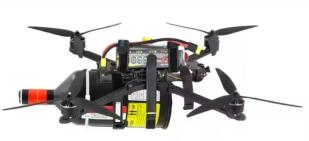
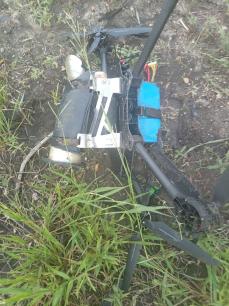
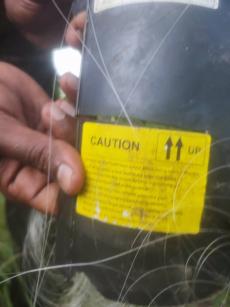
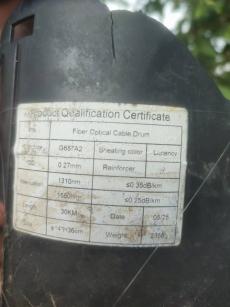
Figure 12. Type 1: fibre-optic FPV suicide drone (wreckage collected at Kurmuk, Al-Baraka and Dindiro, 28 July 2026).
Type 2: long-range one-way attack drone
The long-range drone is the aircraft whose flight computer is analysed in Exhibit A. Its 1,000 km range places every major Sudanese city within reach of the Ethiopian border: from Asosa, Khartoum lies 657 km away and El Obeid 592 km.
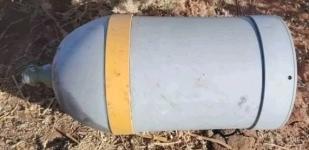
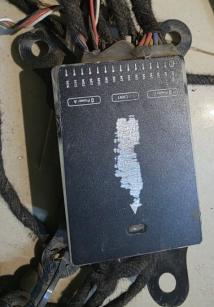
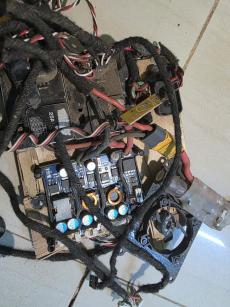
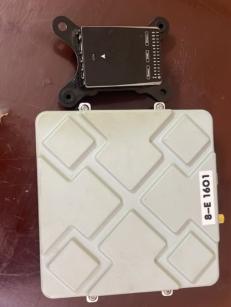
Figure 13. Type 2: long-range one-way attack drone (wreckage collected at Ad-Damazin, 20 September 2026).
Type 3: short-range AI-enabled flying wing
First observed in September 2026, this electric flying wing carries a camera, a datalink and an artificial-intelligence module for target identification and tracking, features not found on the other one-way drones used against Sudan. Its range of 25–30 km again requires a launch position close to the target.
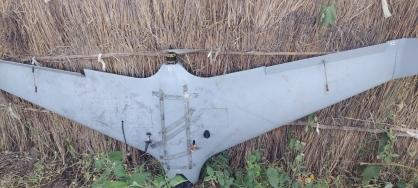
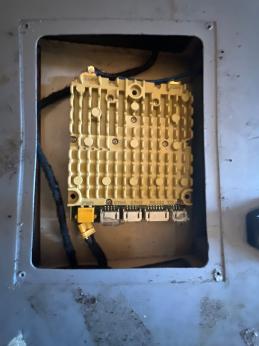
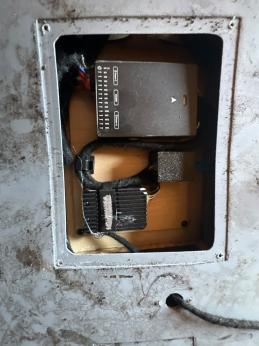
Figure 14. Type 3: short-range flying wing with AI-assisted target tracking (wreckage collected at Bulang, 4 October, and Um Darfa, 7 October 2026).
The physics of range
After the Sudanese Armed Forces liberated Kurmuk on 8 July 2026, the towns and army positions of the border sector were once again held by Sudanese forces. Yet from 21 July onwards, Kurmuk, Al-Baraka, Al-Kaili and Dindiro were struck again and again by salvos of short-range suicide drones: 27 in July, 43 in September and 69 in October. A drone with a 30 km reach must be launched within 30 km of its target, and the 30 km envelope around these positions extends deep into Ethiopia (see the map). Drawing on the direction of approach, the recovered wreckage and the weapons' range, the incident log attributes these salvos to the Ethiopian side of Kurmuk, directly across the boundary. The salvos that struck Ad-Damazin, Khartoum and Omdurman lie far beyond a 30 km reach; they belong to the long-range class analysed in Exhibit A.
Finding C
Three distinct classes of attack drone are in use on the Blue Nile front. The short-range classes cannot reach their targets except from positions within 30 km; the long-range class carries in its memory a take-off point inside Ethiopia. The arsenal is Ethiopia-based.